Showing posts with label Fodder. Show all posts

Sunday, April 19, 2015

HOMESTEADING. WHY WE'RE CRAZY ENOUGH TO DO IT.

Its not about why we do it. It's more of a how...

You see we wake up everyday, and no not always at the crack of dawn... These days we sleep in a little later. We did just have our second child after all.... We head outside and get our first deep breath of the that cool crisp morning air, and breathe it all in. By 'all' I mean the essence of manure, the smell of the dew, usually some hint of smoke (if you're from around my parts you'll understand with the constant prescribed burning) and yup more poop; cow manure at the neighbors, rabbit scat, chicken droppings, water fowl goo here and there from ducks and the goose who free range the property, and then you've got the heaps and heaps of horse manure.... 

Any body need any manure for their compost or garden beds??? Come on down!! TAKE IT AWAY... Like yesterday..

Please...?

Okay, ok but really... We have more than enough to go around.. Scooping manure is a constant filler task. What I mean by that is, tasks that are continually ongoing, basically we will be doing these until the end of time. Poop scooping is just one of those tasks on the homestead, if you don't like it or love it, maybe this lifestyle ain't for you! 

Alright, you don't have to LOVE shoveling animal dung, but, you have to understand and respect its necessity to all farm stead animals. 

Our backyard plays a harmony of sounds finches who have once again taken up residence in our aspen just outside the chicken coop, a couple hens obviously laying eggs, and the ducks splashing away in their pool, Lucy goose honks supervisorly. The first task of the day for my farm stud (as I now spend much of the morning tending to our newborn) include: feeding the horses, all 5 of them. Under the shelter of the barn, also resides the two pigs not far from finishing. With the help of barley fodder, they express their gratitude oh so loudly. We provide loose hay for them at all times, they munch, not eating much, using it mostly for bedding. Spencer checks all their water daily. Maintaining proper hydration is mandatory for horses, especially with all the roughage they receive on our non uniform pasture. Even more so for swine, who are very susceptible to heat stroke. 

Our little farm girl has usually arisen by then and seeks something to fill her tummy. Much of the other chores can be completed through the day. With a toddler and new born sometimes the chore timeline changes... Daily. You see, sometimes I'm not perfect.... Hard to believe I know! Sometimes I do my chores a little late and yes sometimes certain tasks take precedence over chores.... Like trying to nurse a sick gosling, and failing.... Or even nursing a newborn!

When I do finally get to the chicken coop I do my I initial egg check, make sure the water is full, and throw some sprouted fodder for all the birds. 

Right outside the chicken coop our rabbits lay peacefully as they wait oh so patiently for fresh picked weeds I snagged for them on the way. Honestly they are the only animals on the homestead who are patient and don't rush me at the sight of food. 

Maybe that's why I love them so much.
Those furry bunnies bring me more joy than I ever thought they would, and they are so simple! 

I free feed them a local organic pellet feed, weeds or cut them some fodder as a special treat! This summer I plan on weaning them off the pellets completely in an effort to pasture or grass feed them. 

The homestud is actually helping me to complete a vision I have to build a rabbit run out of an old flower bed over run by weeds and wild flowers. Hopefully by next week my bunnies will be converted to the colony high life with more to eat than they can keep up with. 

Many of these chores are repeated in the evening; feeding horses and pigs, throwing sprouted fodder for the birds, checking all waters. The rabbits usually only need more pellet feed every 2-3 days, but as they drink a large amount their water can need filling twice daily at times. In my dream works they would have a drop water system... A girl can dream!

And there ya have it! We're now free to garden or whatever else needs attention. Granted there's usually always something needing a fix or a mess to be cleaned. But at the end of the day we're never bored with our crazy life. 

You see, we get to view the fruits of our labor everyday! In the eggs we collect, those trays and trays of veggie starts, potato and onion sprouts making their appearance above soil, the promise of meat soon to be in the freezer... All organic and nonGMO ta boot! We find happiness in becoming producers, not consumers. And that fills us up. 

We only wish to provide a wholesome, healthy, and educational lifestyle for our brooding quiver of kiddos. Life skills like these will only become more valuable to my children's generation as we head into the future of this crazy world. I only wish we'd jumped on the wagon sooner!

Sharpening knives. 
Rabbit stew tonight..

Amen to this life. 


Saturday, April 11, 2015

RABBIT KINDLING. BEFORE...AFTER...NOW WHAT?

Animal Husbandry.

Just the idea gives me butterflies in my growing baby bump. And no its not my second baby girl doing somersaults! 

The words take me to a nostalgic time of old fashioned men and women heading out to the barn in hope of what treasures they may find. The gift of new life and the promise of food to come for their families table. Oh the excitement of attempting to catch these mamas to be as they welcome their young into the world. I imagine old flannel blankets wrapped around an orphaned lamb, a proud first time cow cleaning her stumbling calve, or a farmer peaking into the nest in search of fresh hatch lings. The practice of breeding ones farm animals for production is an old and true trade.

As I stepped into my muck boots, tucking my sweat pants in oh so fashionably, I was overcome with excitement! Get me outside ASAP! I quickly tucked my messy bun into Carhartt hood as I strode outside. No matter what I'd find, I was looking good..... 

Okay, back to the task at hand...

DRUM ROLL PLEASE!!!!
after months of anticipation...........
...................................................................................................................................................................

CHESTER IS FERTILE AFTER ALL!!! Now a daddy of seven New Zealand kits.


WOO HOO! I knew ya had it in ya buddy!

As many of our readers already know, on Tuesday we welcomed a bundle of new babies onto the homestead! They weren't as cute as some we've seen but they've certainly been anxiously and at times impatiently awaited. If you need a little background on my rabbit breeding mishaps check out this post! Quincy the rabbit pimp, the struggle is real.... trust me. Rabbits bredding like, well rabbits, was not as easily achieved as I anticipated. So, as you can guess I was more than insanely excited when my friend Lexi noticed our rabbit Belle had pulled a substantial amount of fur Monday afternoon..... You can also guess why the blog has been neglected this week....

DUDE!..... that's A LOT of fur......

Yessssssss!............ victory dance commencing.....


By the crack of dawn Tuesday morning we had 7 healthy kits. Squirmin' and a squeakin'! Since this is my first kindling experience I spent a matter of a few hours on Monday and Tuesday reading up on kindling and kit care. For those of you who don't know, to kindle is the act of the doe giving birth to kits, or baby rabbits. Just as cows calve, horses foal, sheep lamb, and rabbits kindle. So... I have all these kits... Now what?

Belle is a great mama, I was told this by her previous owner, and am happy to now be experiencing her calm and cool technique. She had no problem with me reaching right into the nest box to check her babies out. It is important to check for any cold or even dead kits, to either make an attempt at saving or be remove from the nest, if you don't the mama could eat them. It is imperative that the kits stay close together and properly insulated with enough of mamas fur and whatever bedding material you chose. We have been giving her fresh hay daily to maintain the nest and for intermittent munching. Bottomless food and fresh water are paramount for a nursing mama and provided daily, in addition to rations of alfalfa which we incorporated after the hair pulling was noticed.

This may seem crazy but does only nurse their young once or twice every 24 hours. The proteins in their milk increase with the age of the kits, giving them enough for energy and growth. Other than the daily checks I've been performing, and since Belle is an attentive mother, no interventions or special treatment of the kits is needed until weaning. In just 5 days of life, I have been amazed at how exponentially they grew from just one feeding a day. Born pink and virtually hairless, they are now getting whiter and accumulate more fur everyday. And boy are they ever getting cuter! For now I will just be doing my routine daily checks and let mama do her thing.


The babies eyes will open in a week or so (about 12 days old) and in just a few short weeks they will be jumping in and out of the nest box independently. At that time they will begin wandering out to eat some pellets and whatever leafy greens (fodder or weeds) I've given them. At 6 to 8  weeks the kits will be weaned and moved into their nursery where they will plumpen up for an additional 4 to 6 more weeks until proper butcher age. Their nursery will hopefully consist of whatever pastured pen we've thrown together to allow grazing on the tons of grass sprouting all over the property. Hopefully it will be devised to be moved to a new location daily. As you can see I've put great thought into it...... More on that later.


I'll post about here on the blog about all my haps and mishaps, let me be your trial run! It's always nice to watch someone else screw up so ya know what do avoid right?

And please by all means, feedback is warmly welcomed. Leave a comment or email me with your trial and error stories.

Fryer rabbit recipes???

Q


Saturday, March 21, 2015

WHAT THE FODDER?

Recently, we've been encountering more and more people who want to know what the buzz with fodder is all about.

So what, you water it and just watch it grow? 

Well, in an essence yes.....

Fodder came into my life at the perfect time. I had seen these 'fodder systems' begin to stream across my Pinterest page more and more. I had to know what this was...

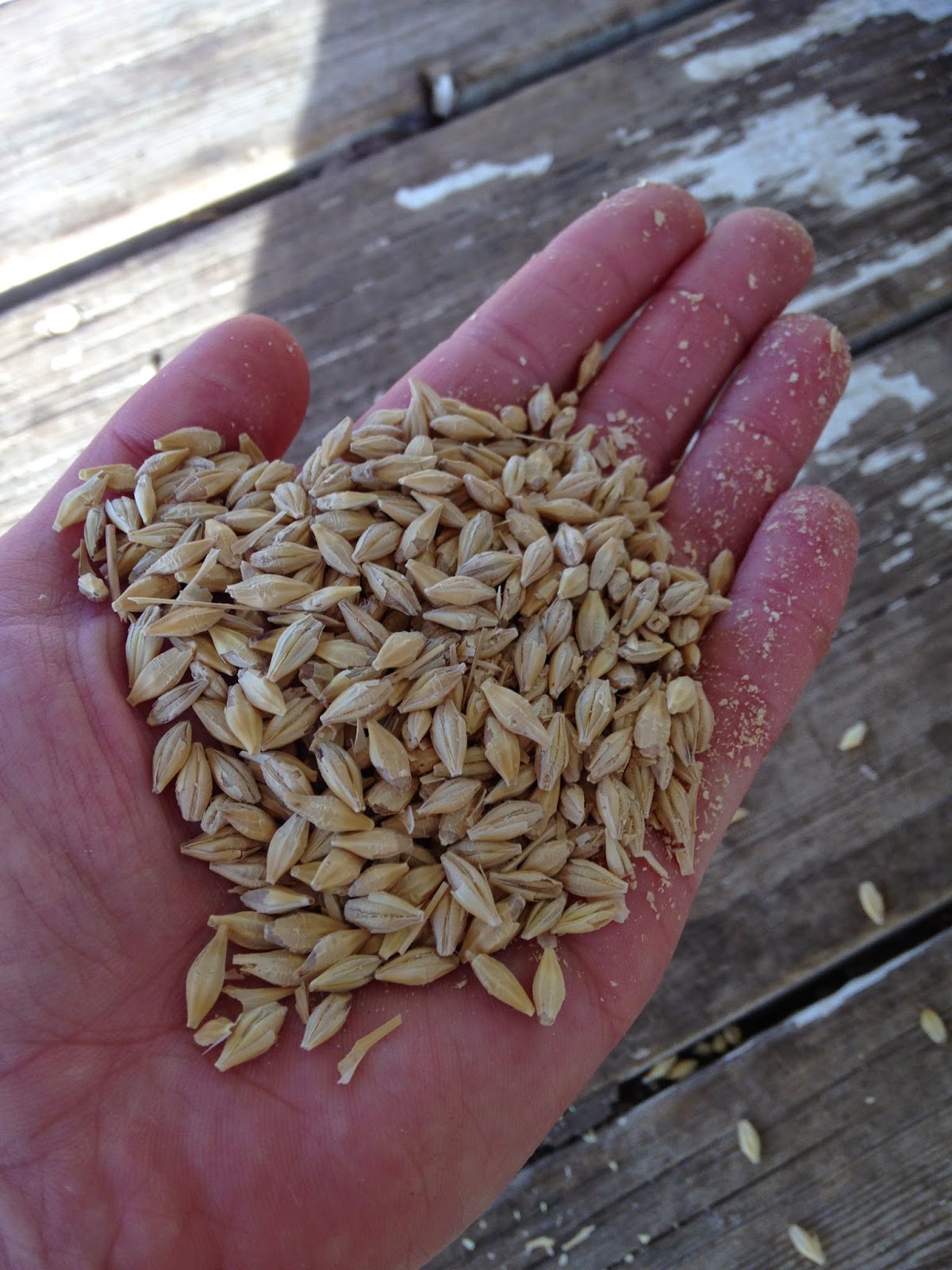
Basically, fodder is sprouted grains or legumes that can be fed to all kinds of livestock.


I could go on and on about the bonuses of maintaining a fodder system. Ok maybe I will just a little, here's as short a list as I could make:
1. Fodder can be grown in the dead of winter.
2. Fodder only takes 8-9 days to grow.
3. 50 pounds of seed can be turned into 300 pounds of fodder. 
4. Whoa! Should I just stop??? 
5. Fodder is very affordable (depending on location) From my supplier I get 50 lb. bags if barley for $10. That's cheaper than a bag of organic hog feed, and it gets multiplied by 6!
6. That's reason enough right?!?
7. Our fodder is GMO-free. 
8. And organic.
9. Horses and cows eat it, after acclimation. The hogs LOVE it. The birds (chickens, waterfowl) LOVE it. On day 7 the rabbits receive clippings from the top, and devour it! All of my livestock eat it. 
10. Need I say more???

There's nothing like it..... Other than a fully sprouted pasture, I don't know about y'all but I don't have one of those in December, do you?  Didn't think so....


The only draw back to fodder I can see feeding is that's it's another commitment. Adding another task to an already busy homestead can be risky, but this one is so worth it. To keep on schedule you need to start a batch a day, in order to harvest for feed everyday. That's only if you're trying to feed solely fodder. We have chose to supplement with fodder currently. Our system is small and the homestead fund weighs I favor of some heavier tasks at hand. 

These days breakfast for the farm hogs consists of the fodder with a scoop of organic local hog feed. Dinner of combined fodder/kitchen scrap mixture. The birds all get their scratch feed mixture thrown daily as they free range and if we have enough fodder for the day they'll get a big chunk to spend the day on. Our rabbits also have a supplemental pellet/fodder grass mixed diet. We also provide the bunnies with feeder or orchard hay at all times.  When feeding livestock on fodder its helpful to incorporate grains and legumes, evenly if possible, into their diets in order to balance vitamins and minerals. Adding rations of diatomaceous earth can also be very beneficial to their digestive systems.

Since I began my fodder adventure about 6 months ago I have learned a tremendous amount. I've been lucky enough to learn a great deal from our supplier. He loves just 2 miles away and is full of fodder knowledge, and is more than willing to give it. Lucky me! If I haven't said before, farm tasks are my favorite.... so naturally, learning more about them is even more my favorite! Being open to ongoing education is a key aspect of homesteading, but I'm sure ya'll know that. So, I am always looking for better more efficient ways to accomplish our bazillion homestead chores. Yada yada yada back on topic Q!

Here's me excited to feed our new bunnies fodder for the first time couple months ago! BTW they loved it, now they can't get enough!!!

Recently I visited a local dairy, while tasting their fabulous milk, the owner gave me a tour of their fodder system.

Take pictures, measurements, make yourself at home.

He then strolled off to assist his friend with an automobile mechanical repair. 

And, of course, I have read and read..... and read about fodder until my eyes hurt. But nothing compares to seeing it in real life, and having those face to face exchanges. Yeah yeah I might be talking sprouted grass but hey, this mama doesn't get off the farm often these days. I'll take fodder conversation where I can get it! Above all I'm grateful for his generosity with knowledge and transparency of start up cost and up-keep of his system. 

My most recent take away lesson in fodder is bleach. Nasty smelly wonderful bleach. I've tried direly to remove bleach from out household for some time but it keeps making it way round and always proves it's worth. It's so harsh that when someone told me to put a little in the fodder water I was flabbergasted. 

In the water that grows the food I feed to my animals?!?!?

Heck no I won't!!!  

But in all honesty I should have listened...

Why?

The mold came....

Yup, this wonderful fodder gets really moldy really quick. And boy howdy does it ever stank!!!

Okay, I give up! I'll put a splash of bleach in there! You got me. 

Fortunately the pigs and chickens don't mind the mold too much but horses and cows won't prefer it. I urge you to experiment and test your own theories before you decide to use bleach. Then give me some feed back, would ya??? I would love to find a non bleach remedy for the mold. 

Luckily it's a small amount. Here's how I incorporate the bleach into my fodder routine:

1. I weight out the desired seed into a large container, using an old stock pot currently
2. Fill with water, add 1 tbsp bleach, stir, soak 10-15 minutes
3. Rinse barley thoroughly, refill container with water, soak 12-18 hours
4. Strain off seeds, pouring out water and chaff
5. Pour seeds into trays, drawers, tubs, whatever growing container you chose, and spread out evenly. We are currently using some plastic storage drawers. I'm looking into changing this up a little possibly (further posts about upgrades to come)**you will have previously made drainage holes for water to flow through
6. Water twice daily, rinsing water over seeds
7. No light is necessary until day 5-6, natural window light counts. Fluorescent light also appropriate
8. Feed on day 8-9

As you can see this is a very simple system, but it works very well for the small scale farming we do. And there are many more styles and procedures out there, I am an amateur folks. I simply want to share the knowledge I have thus far with the hopes that my trial and error helps in anyway. If we incorporate more animals later we may upstage to some fancy fodder system with a water pump and everything! Girlfriend can dream can't she?!

Until then I will simply rinse my fodder daily making sure no standing water is left, and yes I'll use a little bleach here and there to kill mold.

Fodder is such an efficient, healthy, and cheaper way to feed livestock our livestock.  Plus, it gives us gardening guru's some therapeutic attention over the frigid gloominess of the winter months. I highly recommend doing some research on fodder costs in your area to assess its affordability and integrity in comparison to your farm or
homestead.


^^There's me..... again^^
Way to excited about fodder.... again....

Happy sprouting folks!

Q


Sunday, February 15, 2015

FODDER FRENZY

This week on the homestead I strayed a little from my ever mounting to-do list. Any homesteader knows there's more work than rest involved in our lifestyle and at times the tasks can be overwhelming. In these times I look to those tasks which relax and center me in order to let go of some of this chaos.

Oddly enough one of those tasks is my fodder system. Tending to those little sprout lings brings me more joy than I ever could have imagined. 

Maybe it's the fact that I'm growing feed for our farm stead animals completely from scratch! 

Or maybe it's the fact that I can turn a 50 pound bag of barley seed into 300 pounds of fodder feed. 

It could even be the fact that I can feed my livestock fresh sprouts in the dead of winter. 

Or maybe it's just the ease at which I can pick up our bags of barely just a mile and half down the road. 

All of these are great reason for this lady to spend some time with the seeds! Just think, that is 6 pounds of fodder for every 1 pound of barley seed. So if a horse needs between 1.5-3% of its body weight in roughage per day then, for my girl Sweet Pea, who is roughly 1000 pounds, she needs anywhere from 10-12 pounds of feed per day..... Do you realize 1 pound of seed made into fodder covers about half of her intake for the day??? That's what I'm talking about!

OK, Q, what is this fodder that you speak of???


Basically its immature grass sprouts grown in trays to about 8-9 days maturity--depending on what your feeding, and the light accessible to the sprouts.

I grow my small amount of fodder in plastic storage drawers and it works great! At this point I am only supplementing my farms diet, but next winter I hope to provide at least 50% of the animals' diet with fodder.....

All you need to do is water the fodder twice a day, or keep it just moist enough so the sprouts will not dry out, and you're gravy! I have even heard it is best to recycle your water. I do this for a few days before changing the water, it starts to smell yucky especially in warm season when flies will be attracted to it.... and commonly drown in the water.... not so yummy. So use new water or recycle the old, especially if installing a pump system (my dream fodder system would have one!), whatever works best for you and your animals.

(Day 6: Rabbits love it about this age)
--Don't mind my chipped polish ;)--

Just imagine the possibilities!!! 

This means I can feed all of my animals fresh sprouted barley grass through the winter... A form of protein which is very important to foraging farm animals. Especially my free range chickens and horses. 

My hens and ducks prefer it around day 3-4 since the sprouts are still very new and white. Our hogs will eat just about anything so they like it at any stage, but like the birds I see the sprouts and seeds consumed but most of the greens left behind. So I find the older I let the fodder mature the more likely it will go to the rabbits and horses. 

Maybe a system like this???

I have ample space in our laundry room. It is a separate room inside our detached garage with lots of space, and the place I germinate my fruits and veggies (which I cannot wait to start!). 

So there it is. One of the easiest ways to feed your livestock that you never new about..

Bada bing bada boom
Watering the fodder,

Q